
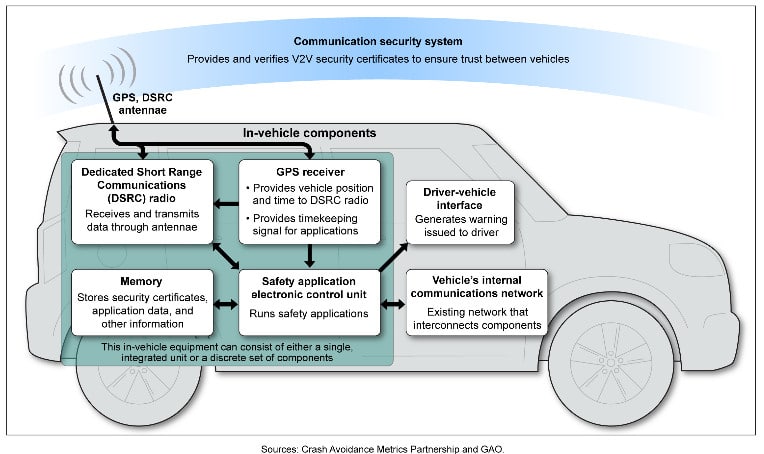
That’s the conclusion of a new report from the Government Accountability Office (GAO), which finds that vehicle to vehicle communications are poised to take off, but that significant security and privacy challenges must first be met, identity management top among them. The report, GAO 14-13 (PDF available here) takes the measure of what the GAO calls “Intelligent Transportation Systems,” including vehicle-to-vehicle (or V2V) technology. The GAO found that V2V technology that allows automobiles to communicate with each other in ways that can prevent accidents has advanced considerably in recent years. Automakers, working with the Department of Transportation, are testing the technology in real-world scenarios. However, the deployment of V2V technologies faces a number of challenges, with security chief among them, GAO found. The Government’s watchdog agency reviewed documentation on V2V technology-including related efforts by DOT and automobile manufacturers. GAO staff also visited a pilot study of V2V technology that is being conducted in Michigan. Automobile executives were interviewed, as were subject experts on V2V technology as part of the review.
You might also like "When Autonomous Vehicles Crash, Is the Software Liable?"
GAO said the auto industry and regulators still need to agree on a technical framework and management framework that will constitute a V2V communication security system. Among other things, the DOT needs to make sure that V2V radio-frequency communications will not be interrupted by other radio devices operating in adjacent parts of the radio frequency (RF) spectrum. Automobiles will also need what GAO called an “external communication security system” that will “ensure that data being transmitted among vehicles are secure and trusted and have not been altered in the transmission process.”


