

Cybercriminals have commandeered everything from home routers and security cameras to digital video recorders and TV set-top boxes to build massive botnets. Now researchers say they have found another Internet-connected device being pressed into service: your car’s infotainment system.
Researchers at Kaspersky say they discovered malware spreading through the built-in software update mechanism of Android-based automotive head units and turning the devices into nodes in a proxy botnet. The discovery marks what the security firm calls the first documented case of malware found on a car head unit with an infection chain specific to that type of device, according to a post on Securelist, Kaspersky's research blog.
The finding is just the latest indication that the line between automotive cybersecurity and the security issues facing the broader Internet of Things (IoT) is becoming increasingly fuzzy and difficult to discern. Modern vehicles contain powerful, Internet-connected computers running familiar operating systems and applications. And, for cybercriminals on the hunt for computing power and dispersed, residential IP addresses, those systems increasingly look like any other vulnerable IoT device.
Malware Hitches A Ride On Software Updates
In a blog post on August 21st, Kaspersky researcher Dmitry Kalinin said the company discovered the previously unknown Android malware while monitoring threats in June. The malware initially stood out because it installed as an ordinary Android application but had no user interface — suggesting victims weren't installing it themselves.
Kaspersky's investigation traced the infections to Android-based head units manufactured by DoFun. Kaspersky said the malware was delivered using TWCore, a legitimate system application used to collect analytics and update the head unit's software. TWCore's update mechanism could install applications that weren't already present on a device, giving attackers a ready-made distribution channel. Kaspersky said it notified the vendor, which subsequently reported fixing the security issues.
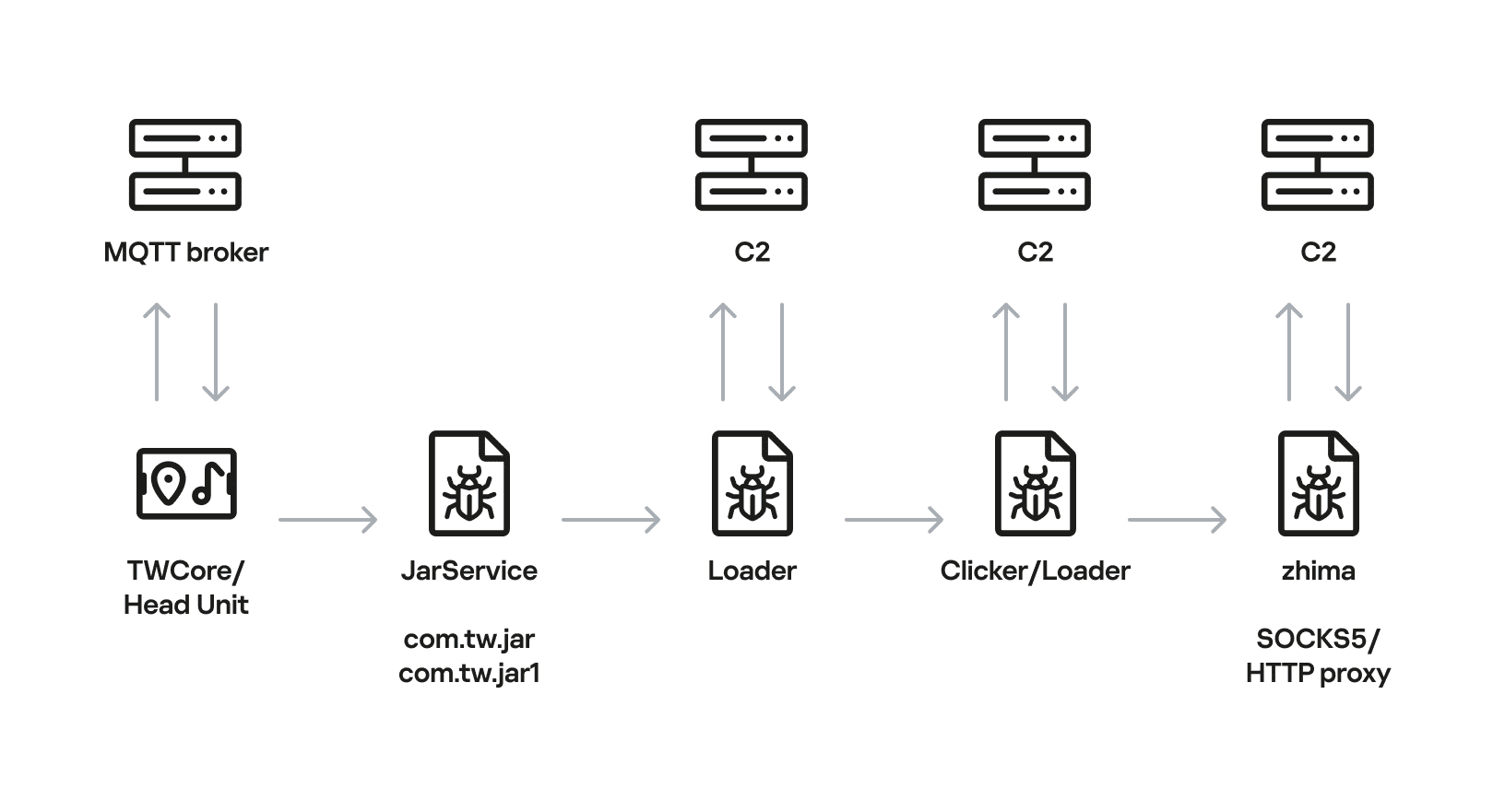
Head unit infection scheme (Source: Kaspersky Lab)
What followed was a multi-stage infection. The initial JarService dropper loaded a second-stage component, which contacted command-and-control infrastructure to retrieve another payload. That third stage could display advertisements, conduct ad fraud, download and execute additional code and install a reverse-proxy module dubbed “zhima.”
“The attackers’ ultimate goal is building a proxy botnet,” Kaspersky researchers concluded after analyzing the reverse-proxy component. The company attributed the campaign with high confidence to the MoYu Group, an actor previously linked to the BADBOX malware operation, which infects low end IoT devices such as smart television sets, digital picture frames and other devices. The FBI warned that the botnet allows cybercriminals to mask their activity by leveraging compromised devices on home networks, also known as residential proxies. Malicious attackers have also been observed selling access to the botnet to other cybercriminals, the FBI said in an alert published in June, 2025.
“The public is urged to evaluate IoT devices in their home for any indications of compromise and consider disconnecting suspicious devices from their networks,” the FBI said.
Recent research from Lumen Technologies' Black Lotus Labs underscores the scale of that phenomenon. The company's researchers say they track nearly 20 million distinct IP addresses per day across more than 30 malicious proxy botnet clusters. More than 20 of those clusters regularly exceed 100,000 victims a day. Compromised IoT, small-office/home-office (SOHO) and mobile devices provide operators with huge pools of residential IP addresses that can be rented or resold to conceal fraud, credential attacks, scanning and other malicious activity.
Black Lotus Labs warned that the proxy ecosystem has effectively created a collective botnet capable of shifting millions of IP addresses within hours. In one campaign earlier this year, attackers exploited residential proxy infrastructure at a scale approaching 400,000 distinct IP addresses in a single day.
Nation-state hackers are playing the same game. Black Lotus Labs recently documented the resurgence of the JDY botnet, a reconnaissance network linked to China-nexus threat activity including Volt Typhoon. JDY comprises more than 1,500 compromised SOHO and IoT devices from manufacturers including Cisco, Araknis, Draytek, Hikvision and Linksys. The infected systems continuously scan the Internet and fingerprint exposed services, providing reconnaissance that can be used to rapidly target newly disclosed vulnerabilities.
Your Car Is Just Another IoT Device
The campaign fits into a much larger shift in the cybercriminal economy: attackers are increasingly exploiting poorly monitored IoT and consumer devices not necessarily for the data they contain, but for their Internet connections.
Kaspersky itself noted the attraction. Because automotive head units may include SIM slots and Internet connectivity, recruiting them into botnets is “similar to attacks on IoT devices,” the researchers wrote.
The Kaspersky findings also arrive amid mounting evidence that connected vehicles and the services surrounding them expose a sprawling and poorly defended attack surface.
Earlier this month, we reported on vulnerabilities in the My Eicher fleet-management platform that exposed more than a quarter-million commercial vehicles in India, along with sensitive driver information, to potential remote compromise. Researcher Eaton Zveare discovered unauthenticated APIs that enabled account takeover and access to fleet telematics information.
That incident followed a long list of automotive security disclosures, from the landmark 2015 remote compromise of a Jeep Cherokee to vulnerabilities disclosed in 2023 that exposed Subaru vehicle and driver information. Despite those incidents, there are still no U.S. federal cybersecurity requirements governing vehicle telematics software; federal guidance remains voluntary.
The Kaspersky discovery adds a new wrinkle to that story. The attackers weren't trying to steer vehicles off the road or steal information from drivers. They simply saw an Internet-connected Android computer with an exploitable software distribution channel and turned it into infrastructure.
In other words, the security problem may be less exotic — and more pervasive — than fears about hackers taking control of cars suggest. As vehicles become collections of networked computers, attackers don't necessarily need to care that they're cars at all.


