

In this episode of the podcast (#267) we welcome Silas Cutler, the Principal Security Researcher at Censys to discuss two major cyber incidents in recent weeks: the disclosure- and exploitation of two, critical flaws in the PHP scripting language, and attacks on refrigeration management systems by the firm Danfoss that resulted in tens of millions of dollars of losses in France.
[Video Podcast] | [Download MP3] | [Transcript & Podcast Links]
My original plans for this podcast were to invite Silas Cutler of Censys into the SL studio to talk about the mind-blowing hacks on refrigeration management systems manufactured by the company Danfoss that affected hundreds of supermarkets, caused tons of food to get spoiled and generated tens of millions of Euros in damages.
But, while Silas and I were getting ready to have that conversation, an even bigger incident came to light: a pair of critical flaws in PHP - a widely used scripting language that is the foundation for an untold number of websites, web applications and more. It would be hard to do a cyber podcast in the last week and not talk about PHP.
Sure, the PHP flaws and the cyberattacks on supermarket refrigeration controllers might seem like separate security stories. But both expose a familiar problem: our global economy’s deep reliance on widely deployed technologies that can remain accessible to attackers long after they lose the support of manufacturers and developers - and even the awareness of owners and operators.
On this episode of the Security Ledger podcast, Censys researcher Silas Cutler and I dive into all those issues: the recently disclosed PHP vulnerabilities, attacks on Danfoss refrigeration controllers in France, and the widening gap between finding security flaws and protecting affected systems.
PHP2Shell: Tens of Millions of Targets
The PHP vulnerabilities, known collectively as PHP2Shell, can allow unauthenticated attackers to execute code on web servers. Fixes were released October 21. Censys’s PHP2Shell dashboard tracks exposed services and patch adoption, offering a window into the response across a sprawling web ecosystem. Its counts reflect services and reported software versions, rather than a tally of successfully compromised machines.
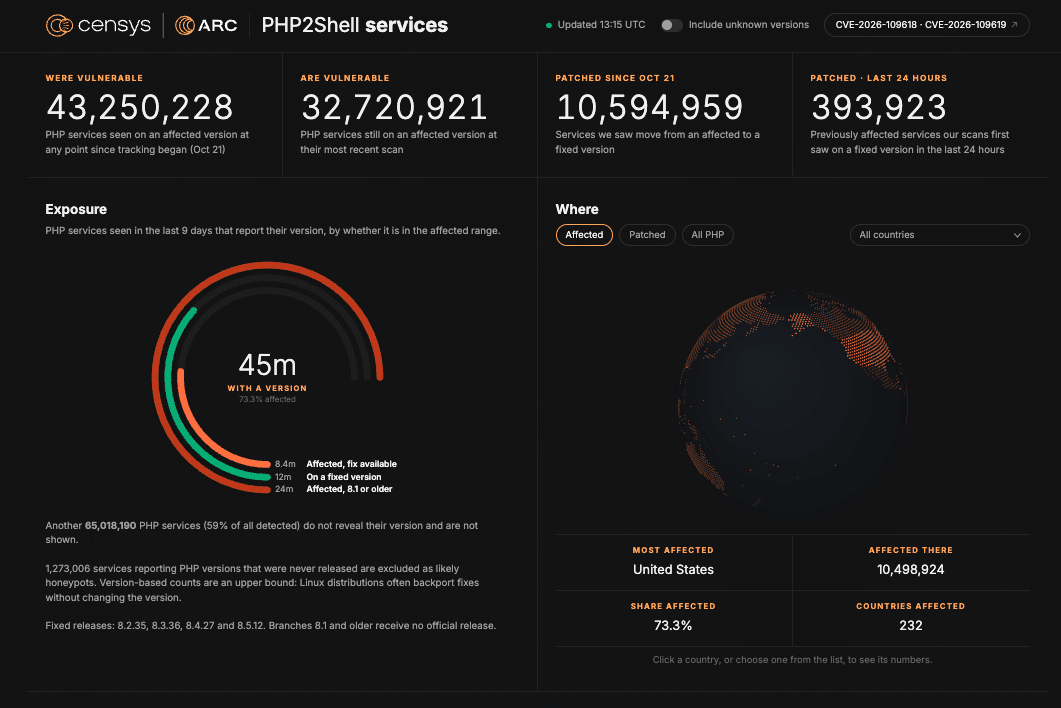
In the interview, Cutler describes exposure measured in tens of millions of web properties, while emphasizing that many websites can share an underlying host. Those figures also change as organizations patch and Censys improves its detection.
And the PHP flaws point to a pressing question: the role that large language model AI is playing in accelerating both threats and attacks. True: researchers are using AI tools to reproduce the flaws, explore related weaknesses and test potential mitigations. But attackers can use those same capabilities even quicker to find flaws like those in PHP and develop exploits. Cutler cautions that a working demonstration against one PHP configuration does not establish that it will work across the language’s many deployment environments.
For defenders, the starting point remains visibility. “One is, first, know your attack surface and know what you have exposed on the internet,” Cutler says. That includes checking vendor notifications for appliances and applications whose PHP dependencies may be hidden from their operators.
Danfoss Fridge Hacks: How Device Security Is Melting
The Danfoss attacks show what can happen when exposed software controls physical equipment. Over the October 10–11 weekend, attackers disrupted refrigeration at hundreds of French supermarkets, forcing units into defrost mode and spoiling food, according to Censys’s investigation. Danfoss had not confirmed the initial access method; the company said most affected controllers were unsupported models or devices running outdated firmware.
Previously disclosed weaknesses included an administrator login code derived from the calendar date and an authenticated command-injection flaw. Researchers had demonstrated how the two could be chained to gain remote code execution. That established a potential attack path, without proving it was the route used in France.
Censys counted 1,825 exposed StoreView hosts in France on October 11. By October 14, that number had fallen to 537. Patched and unpatched populations declined at similar rates, suggesting operators were removing controllers from public access rather than simply updating them.
But the risk isn’t limited to France. In our conversation, Silas discusses his efforts to reach out to U.S. based supermarkets that also use Danfoss hardware to warn them of the risks being exploited on the other side of the Atlantic.
“I (was) looking for small towns where there's one or two grocery stores, and then just calling each grocery store being like, ‘Hey, calling with an odd question.’ But then I realized about three calls in that I was calling grocery stores, asking them if their refrigerator was running, and most of them likely assumed that this was all just a prank call.”
While Silas said he detected fewer than 200 Danfoss systems in the U.S., the problem underscored by the attacks in France isn’t limited to Danfoss and its customers. The bigger question is what steps must be taken to secure such systems - which are kind of peripheral “critical infrastructure.” That includes the need for clarity around what happens when refrigeration equipment remains useful but its software no longer receives fixes. Cutler argues that manufacturers should make room for continued maintenance: “if a vendor says, ‘We're not gonna support it,’ then I think that they should also, in some cases, allow other people to maintain it as well.”
Listen to the full conversation for Cutler’s assessment of AI-assisted vulnerability research, the limits of early exploit claims, and why software support decisions increasingly carry consequences beyond the server room.
Video Podcast
Check out the video recording of my interview with Silas Cutler of Censys. And, if you haven’t subscribed to our YouTube channel, do it now!
Transcript and Podcast Links
Use the links below to access the transcript as well as other related information for the latest podcast.


