

New research published this week highlights a rapidly shifting cybersecurity landscape in which human attackers still dominate, enterprise AI deployments are outpacing security controls, and trusted browser sessions are becoming pathways to persistent compromise.
Research reports released during the week of October 19 from Rapid7, ServiceNow, Securonix and IANS offer a revealing look at the challenges facing enterprise security teams. Taken together, the findings suggest that while artificial intelligence is transforming both cybersecurity operations and the organizations responsible for them, familiar weaknesses - from vulnerable software and excessive privileges, to inadequate visibility and the exploitation of trusted systems- power some of the most pressing threats.
This week’s leading research reports include Rapid7 Intelligence’s Quarterly Threat Landscape Report, which examines the role of AI in the accelerating pace of vulnerability exploitation and related cyberattacks; ServiceNow’s global survey, which uncovered widespread security incidents involving autonomous AI agents; Securonix, which documented a sophisticated attack against WordPress administrators; and IANS Research and Artico Search, which examined how enterprise security organizations are restructuring to address AI-related risks.
Some key themes emerge from the reports.
- Attackers are exploiting weaknesses faster than organizations can respond. Rapid7 found that high-severity vulnerabilities are being exploited within days, rather than weeks, of disclosure.
- AI adoption is creating a growing governance problem. ServiceNow's research suggests that organizations are deploying autonomous agents faster than they can inventory, monitor or control them. Meanwhile, IANS found that responsibility for AI security is increasingly formalized, even as broader accountability remains fragmented.
- Established trust relationships remain attractive targets. Securonix's analysis demonstrates how malicious JavaScript can exploit an authenticated administrator's browser to install a persistent backdoor without defeating the application's authentication mechanisms.
And, while AI dominates security industry discussions, the immediate risks documented by researchers continue to involve human-directed attacks, credential abuse, and well-documented shortcomings in basic security operations.
Rapid7: Human Attackers Still Dominate, but Exploitation Windows Are Closing
Despite mounting concern about autonomous AI-powered cyberattacks, human operators continue to direct the overwhelming majority of malicious activity tracked by security firm Rapid7.
In its Q3 2026 Threat Landscape Report, released October 21, Rapid7 found that AI was identified as an operational component in just 8% of tracked incidents. Human operators still predominantly select targets and determine attack objectives, even as automated tools take on more tactical work.
The more immediate concern is the shrinking interval between vulnerability disclosure and exploitation. According to Rapid7, attackers exploited high-severity vulnerabilities within an average of three days, with 71% of exploitation occurring during the first week. Nearly four out of five exploited vulnerabilities (79%) required neither authentication nor user interaction.

Those findings suggest that conventional vulnerability management processes, which often operate on weekly or monthly patching schedules, may be poorly matched to the speed of modern attacks.
Rapid7 also documented 1,112 ransomware leak-site listings associated with U.S. organizations, approximately eight times the number recorded for Germany. The Gentlemen, Qilin and INC Ransom were among the most active ransomware groups identified in the research.
Monitoring of criminal marketplaces reinforced the importance of compromised access: 41 of 63 underground posts tracked by Rapid7 advertised Remote Desktop Protocol or network access.
The takeaway is clear: defenders cannot afford to focus exclusively on speculative AI threats while overlooking readily exploitable systems. Internet-facing vulnerabilities, compromised credentials and remote-access infrastructure remain central to real-world attacks.
ServiceNow: Nine in Ten Organizations Report Agentic AI Security Incidents
While Rapid7's findings suggest that autonomous AI has yet to become a dominant feature of cyberattacks, new research from ServiceNow indicates that organizations deploying AI agents are already encountering significant security problems.
ServiceNow's October 20 report, Deployed but Ungoverned: The State of Agentic Security (PDF), surveyed 3,766 senior security and technology executives across 20 countries and eight industries.
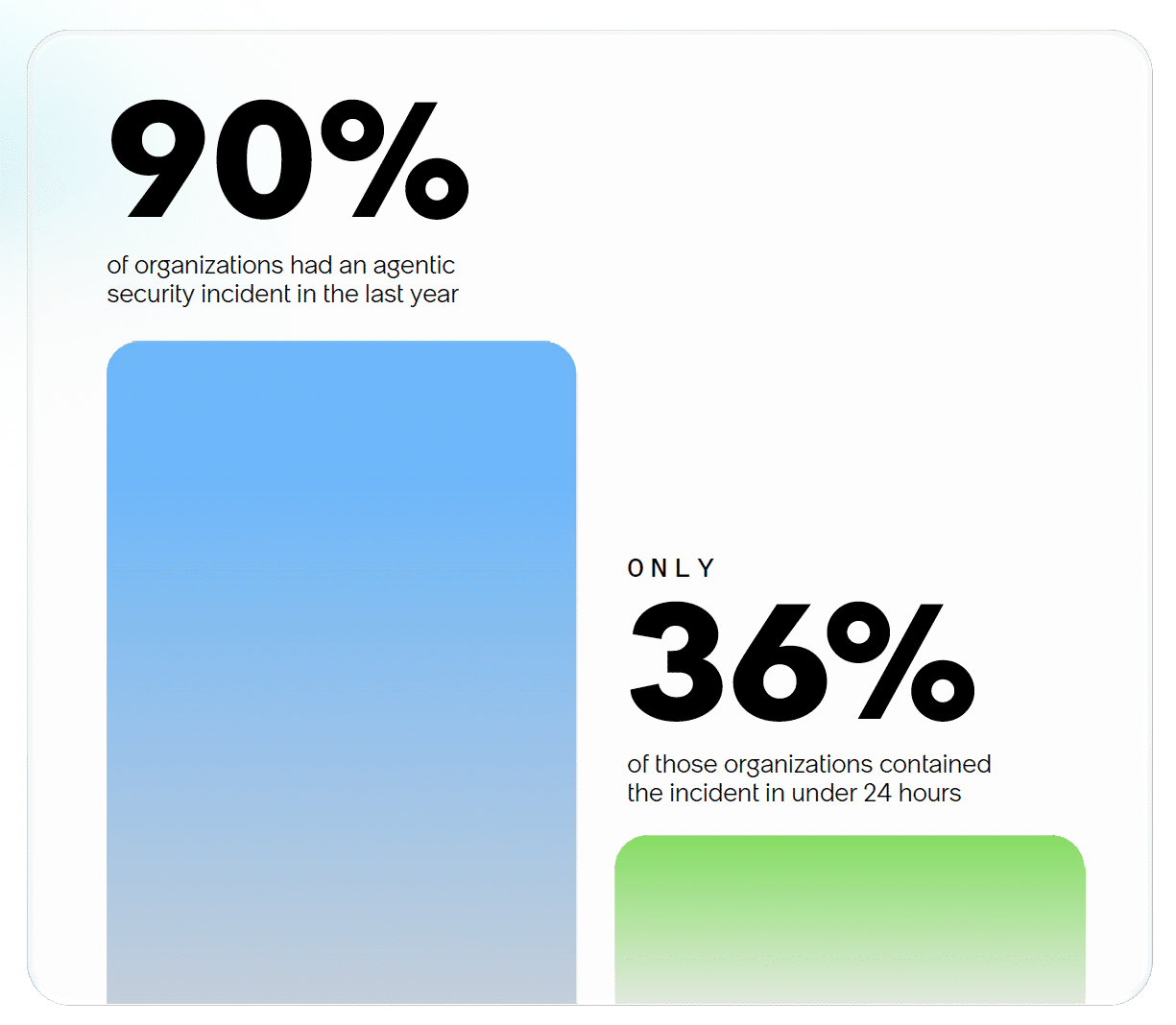
The results were striking: 90% of respondents reported that their organizations had experienced an agentic AI security incident during the preceding year. Of those organizations, just 36% contained the incident within 24 hours. Although 56% of respondents characterized their agentic security programs as established and purpose-built, ServiceNow concluded that only 13% had defensible programs when evaluated against five domains: attack surface, accountability, security by design, visibility and audit readiness.
The findings point to an expanding visibility gap. Nearly half of surveyed organizations operate between 100 and 999 AI agents, while another 35% operate more than 1,000. Yet only 19% of security teams can monitor more than 90% of their agents in real time. Even when suspicious behavior is identified, 66% of organizations cannot respond automatically, requiring human intervention.
The implications extend beyond conventional enterprise IT. ServiceNow found that 82% of organizations operate agents in or interacting with operational technology or physical environments, while 76% reported an incident involving an agent in those environments.
Accountability is another problem. Just 21% of organizations have a single named individual responsible for agentic AI governance. The study, conducted with Phronesis Partners, relies on survey responses rather than independently verified incident investigations. Nevertheless, it raises questions about whether organizations can meaningfully supervise increasingly autonomous software operating across business-critical systems.
“AI agents introduce new and evolving risks organizations aren’t prepared for,” said Neil Gong, an Associate Professor of Electrical and Computer Engineering at Duke University. “Addressing these emerging security challenges is critical to the secure deployment of AI-driven cyber infrastructure.”
Securonix: WordPress Attack Turns Trusted Browsers Into Backdoor Installers
Research from Securonix illustrates how attackers can exploit legitimate administrative privileges rather than bypass authentication.
In an analysis of a campaign dubbed TRUST#GRAFT, researchers Akshay Gaikwad and Aaron Beardslee documented a malicious JavaScript loader designed to compromise WordPress installations through the browsers of authenticated administrators.
The attack begins with a fake Cloudflare-style verification screen. Behind that interface, malicious JavaScript fingerprints the browser, communicates with attacker-controlled infrastructure and searches browser storage for potentially valuable authentication material.
The attack's most consequential feature is its ability to detect an existing WordPress administrator session. When the malicious JavaScript executes in the appropriate site context, it attempts to access the WordPress plugin installation interface, retrieve a legitimate security nonce and upload a malicious plugin using the administrator's existing permissions. The plugin, masquerading as Web Media Optimizer, contains a PHP backdoor capable of injecting additional JavaScript into public pages, hiding from normal plugin listings and providing token-controlled administrative access.
It also copies itself into WordPress's mu-plugins directory, where must-use plugins load automatically and cannot be disabled through ordinary plugin management.
Securonix emphasized that the technique does not constitute an authentication bypass. It depends on an already authenticated administrator session with plugin installation privileges.
Researchers confirmed the functionality of the recovered components but did not establish the original JavaScript delivery mechanism or identify a responsible threat actor.
The research underscores the risks of combining routine web browsing and privileged administration within the same browser context. It also demonstrates how legitimate management functions can become mechanisms for persistent compromise.
IANS: AI Security Leadership Expands, but Governance Remains Fragmented
The organizational consequences of AI adoption were the focus of the fourth report, released October 20 by IANS Research and executive recruitment firm Artico Search.
Their 2026 Security Organizational Design Benchmark Report, based on surveys involving more than 1,400 CISOs and cybersecurity professionals, found that large enterprises are increasingly establishing dedicated AI security leadership positions.
Among organizations generating more than $10 billion in annual revenue, 65% have assigned responsibility for AI security to a named leader. That includes 18% with a dedicated head of AI security and 47% combining the responsibility with another leadership position.
However, formal responsibility for enterprise-wide AI governance remains less settled. Just 7% of the largest organizations assign primary AI governance responsibility to the CISO. Meanwhile, only 21% have fully implemented a board committee dedicated to AI ethics or responsible AI.
The report also illustrates the substantial differences in security resources across organizations. Companies generating more than $10 billion annually employ an average of 172 security professionals, compared with 33 at organizations generating $1 billion to $10 billion and nine at smaller businesses.
Smaller organizations consequently depend more heavily on managed security service providers, with adoption reaching 86% among mid-sized enterprises.
The research highlights a potential disconnect: organizations are creating new roles to manage AI security while leaving broader questions about authority, accountability and board oversight unresolved.
The Bottom Line: Security's Speed and Accountability Problem
Collectively, this week's research points to a cybersecurity industry confronting two challenges simultaneously.
Traditional attacks are becoming faster and more effective at exploiting established weaknesses. At the same time, enterprise adoption of autonomous AI is expanding the number of systems, identities and processes that security teams must oversee.
The common denominator is control: knowing which systems are exposed, which identities possess authority, who is responsible for managing risk and how quickly organizations can intervene when something goes wrong.
The research suggests that those questions—not simply the arrival of autonomous attackers—will define much of the cybersecurity challenge ahead.


