

Artificial intelligence is giving cybercriminals new tools for carrying out attacks. But according to new research from Google, attackers are increasingly interested in stealing AI itself — or, more precisely, the accounts, credentials and computing resources needed to access it.
The latest report from the Google Threat Intelligence Group (GTIG), “From Prompting to Autonomy: The Evolution of Adversarial AI,” finds evidence of a rapidly evolving underground market for stolen AI credentials and a related phenomenon known as “LLMJacking”: the compromise of cloud infrastructure to run unauthorized AI workloads.
The trend is part of a larger transformation of the threat landscape, powered by large language model (LLM) and agentic AI. It shows that AI services have become highly valuable digital assets in their own right, prompting attackers to figure out how to make somebody else pay for them.
The Underground Market for AI Access Is Growing
The report is Google Threat Intelligence Group's first major update since May and documents how state-sponsored espionage groups, financially motivated cyber criminals, and information operations (IO) threat actors are operationalizing AI tools in the wild. The report is based on telemetry from Mandiant incident response engagements, global threat actor tracking, and live platform defenses, according to GTIG, which focuses on identifying, analyzing, mitigating, and cyber threats to Alphabet, its users, and customers.
According to the report, malicious actors access to powerful commercial large language models (LLMs) and the high-performance computing infrastructure needed to run AI workloads is frustrated mostly by the cost of access. In fact, Google says that costs remain one of the biggest obstacles preventing attackers from operationalizing AI at scale.
The solution? Obvious: steal access.
GTIG found growing demand for compromised AI accounts on underground forums during 2026. GTIG said it observed increases both in the number of sellers advertising AI accounts and buyers looking for them. Demand was particularly strong for stolen Claude and Gemini credentials, as well as accounts for autonomous coding environments such as Cursor Pro and Devin.
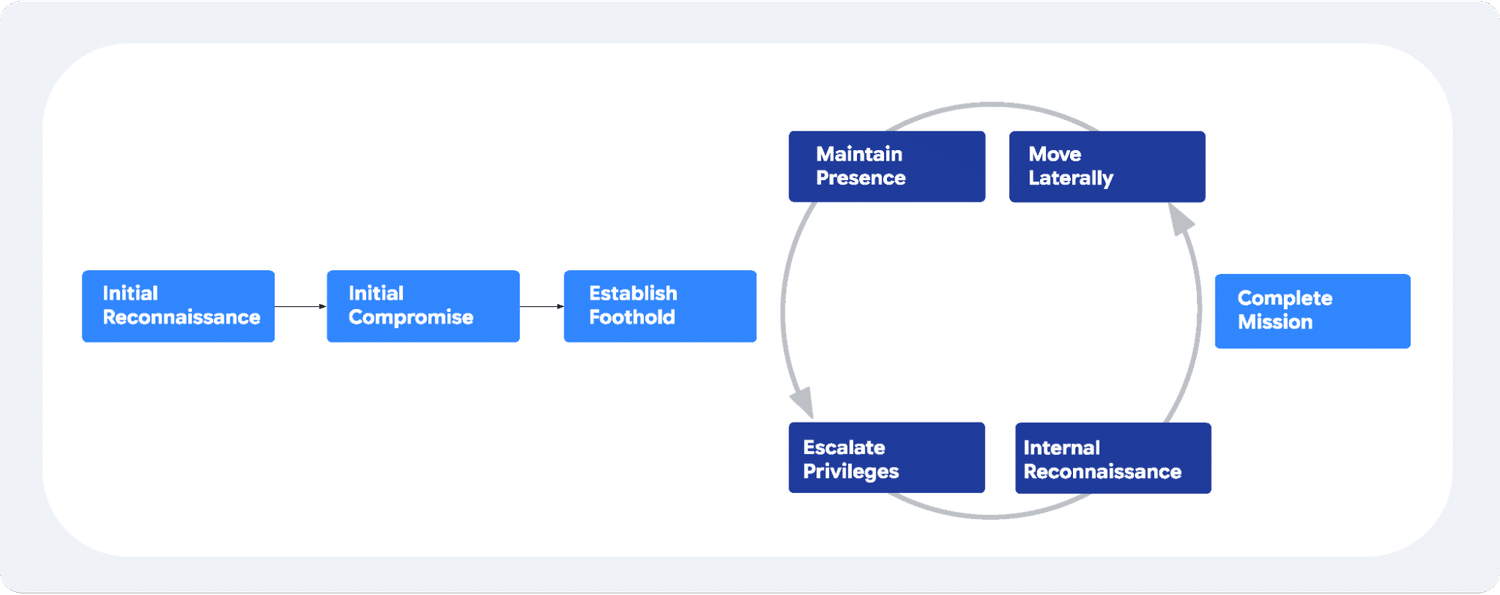
How threat actors are leveraging AI across all stages of the attack lifecycle. (Source: Google)
And, as demand grows, the economics are changing quickly. According to Google, average underground marketplace prices for AI accounts more than doubled in 2026, reflecting the growing demand for access to commercial AI services. Attackers are leveraging infostealer malware to help supply that market. For its report, GTIG analyzed commands sent to prominent infostealers including LUMMAC.V2, STEALC.V2, VIDAR and ACRSTEALER and found evidence that attackers are moving beyond stealing browser credentials to explicitly targeting AI developer configurations.
In May, for example, ACRSTEALER operators targeted configuration files belonging to AI coding assistants Cline and Continue AI. Those files can contain plaintext API keys and model-routing information, potentially giving an attacker direct access to a victim's paid AI quotas and infrastructure.
LLMJacking Moves Into the Enterprise
Stealing an AI account is one way to avoid paying for compute. Compromising an organization's cloud environment is another. That's a phenomenon that Google describes as "LLMJacking," with attackers hijacking cloud resources and using the victim's infrastructure to provision expensive compute and AI services.
In April, for example, an investigation by Mandiant found that an attacker gained access to a cloud environment using an exposed GitHub Personal Access Token and proceeded to enable Gemini Enterprise, provision high-performance compute, deploy AI infrastructure and create a rogue service account with Editor privileges. The attacker also deployed the LiteLLM API and Manus agent framework, enabled generative-language APIs and created an AI Workbench notebook for retrieval-augmented generation workloads. Finally, the attacker requested higher cloud quotas for NVIDIA RTX 6000 hardware and launched additional 48-vCPU instances to sustain the unauthorized AI workloads.
In effect, the victim's cloud account became the attacker's AI data center.
AI Is Also Accelerating Attacks
But LLMJacking is just one symptom of a much (much) larger phenomenon. The latest GTIG report makes clear that attackers aren't merely stealing AI resources. They're increasingly integrating AI throughout their operations.
GTIG and Mandiant observed a suspected financially motivated attacker deploy an autonomous, multi-agent framework inside a compromised cloud environment. Using an AI coding chatbot, prompts and preconfigured instructions, the attacker planned, built and executed a mass credential-harvesting campaign in less than six hours, ultimately compromising thousands of third-party credentials.
The AI agents deployed by the attacker managed vulnerability scanning, troubleshooting and IP rotation with limited human involvement. Google separately discovered an automated reconnaissance and credential-management system capable of organizing and validating more than 23,800 harvested secrets, including cloud and AI API keys.
And that's not all. Other applications of AI documented by Google in the report include leveraging LLM AI for:
- Vulnerability research and rapid development of exploits based on recently disclosed vulnerabilities.
- Automated reconnaissance, penetration testing and credential harvesting.
- Creation and translation of spear-phishing and social-engineering content.
- Malware development, obfuscation and troubleshooting.
- Post-exploitation activities and command-and-control development.
- Analysis and summarization of stolen information.
- Creation of propaganda, fake personas and other information-operations content.
- Manipulation of AI coding assistants and even attempts to trick LLM-based security scanners into overlooking malicious code.
Google cautions that it has not yet observed fully autonomous, machine-speed exploitation pipelines operating against targets in the wild. But its findings point toward progressively greater automation and reduced human involvement.
Nation-State Hackers and Cybercriminals Embrace AI
And AI adoption isn't limited to a particular group of threat actors - whether cybercriminal or nation-backed. Data collected by GTIG shows a trend that crosses the traditional boundaries between cybercrime and state-backed hacking. For example, Google identified BASIN CASTLE, a China-linked espionage group, using generative AI for reconnaissance, localized social-engineering lures, malware obfuscation and post-exploitation troubleshooting. Another China-linked group, RAVINE CASTLE, used AI for intelligence gathering, exploit research and influence operations.
The Iran-linked CALANQUE ION, formerly tracked as APT42, was observed using AI for target identification, OSINT, social engineering, software reverse engineering and summarizing stolen data, while the Russia-linked SANDWORM RELIC, formerly APT44, used Gemini to help develop password-spraying and host-fingerprinting scripts and automate other tasks.
North Korean groups are also prominent. Google observed DPRK-linked actors using AI for target reconnaissance, fake resumes and recruiter personas, phishing research and bulk registration of LLM APIs using hijacked accounts. The North Korea-linked MIDNIGHT NEPTUNE clusters used AI coding tools to develop remote-access Trojans, create social-engineering personas and facilitate lateral movement in cryptocurrency theft operations.
Financially motivated groups are following the same path. Google highlighted UNC6240, also known as ShinyHunters, using AI coding tools to create obfuscated code, circumvent perimeter defenses and analyze stolen data for extortion.
AI Credentials Are the New Developer Secrets
For defenders, Google's report suggests that AI credentials should now be treated like other high-value development and cloud secrets. API keys, AI configuration files, cloud tokens and paid model accounts aren't merely billing concerns. They can provide attackers with access to powerful models, enterprise infrastructure and expensive compute capacity that can be repurposed for additional attacks.
As AI becomes more deeply embedded in development environments and enterprise cloud infrastructure, protecting access to it will increasingly become part of protecting the software supply chain itself.As AI becomes more deeply embedded in development environments and enterprise cloud infrastructure, protecting access to it will increasingly become part of protecting the software supply chain itself.
Read more over at Google.com


